The five stages
Geometric modelling & configuration comparison
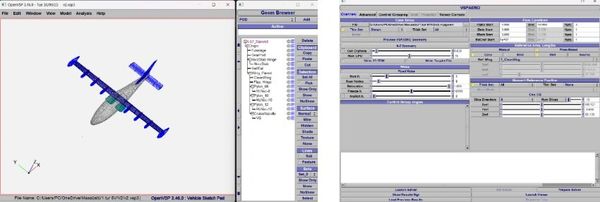
The NASA X-57 Mod IV was chosen as reference (V0) and modelled in OpenVSP. Configurations V1–V5 varied motor number and placement while keeping the wing and fuselage fixed, then were analysed in VSPAERO under cruise conditions to compare CL, CD and L/D. The reference model reached 90.27% agreement with NASA's 2025 CFD results.
OpenVSPVSPAERO6 configurations

Machine-learning design optimisation
Using OpenVSP–Python integration, wing parameters (taper, twist, thickness ratio) and motor placement were swept into 486 configurations, each analysed in VSPAERO. A Random Forest surrogate (R² = 0.972, 5-fold CV) then screened 1,000 candidate designs, and SHAP analysis quantified each variable's effect. The model is served live via a Streamlit interface.
CFD & multidisciplinary performance analysis
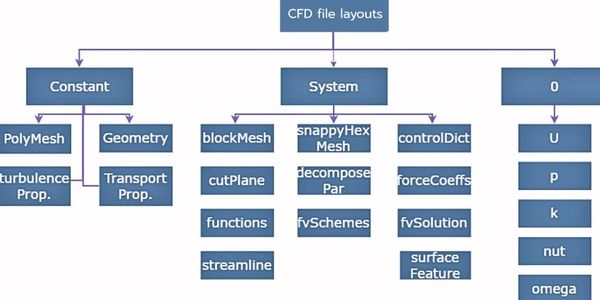
The ML-optimised design was meshed with blockMesh/snappyHexMesh and solved in OpenFOAM at Re = 1.92×10⁶ using the k-ω SST turbulence model. Rotors were represented with the actuator-disk approach as momentum sources. The stage covered aerodynamic forces, rotor interactions, energy–power budgets, convective thermal management and a full flight-envelope assessment.
Quantum-assisted flow modelling
A quantum–classical hybrid represented the flow in a reduced 2-D state space. Ten airfoil sections (K0–K9) were solved with the Lattice-Boltzmann Method (D2Q9) for reference data, amplitude-encoded into Hilbert space, and fed to a PyTorch + Qiskit variational quantum circuit (Ry, Rz, CNOT gates) trained via the parameter-shift rule. A low-depth, NISQ-compatible circuit predicted CL and CD with an approximate 720× speed-up.
Visualisation, experiment & prototyping
Results were turned into 3-D Blender animations of DEP integration and the CFD workflow. A 12×12×70 cm steam-flow wind tunnel visualised stall behaviour in 2° steps, and a 1:9.8 scale, 120 cm-wingspan prototype — 3D-printed PLA wings, foam-board fuselage, drone motors — formed a coupled numerical-experimental validation platform.

Welcome to the AeroQubit
This is a brief interactive preview rather than the full project, giving you a quick look at its key features and concepts. Enjoy exploring!