From first layout to scale model
Five stages, each checked against an independent reference, all with open-source software on one laptop.
Why it matters
Monitoring a wildfire, a flood or a search area means hours in the air. Today that often falls to helicopters, which are costly, loud and burn fuel. An electric aircraft is quiet and has no direct emissions, but batteries hold far less energy than fuel, so every gain in aerodynamic efficiency becomes more time over the area.
The approach
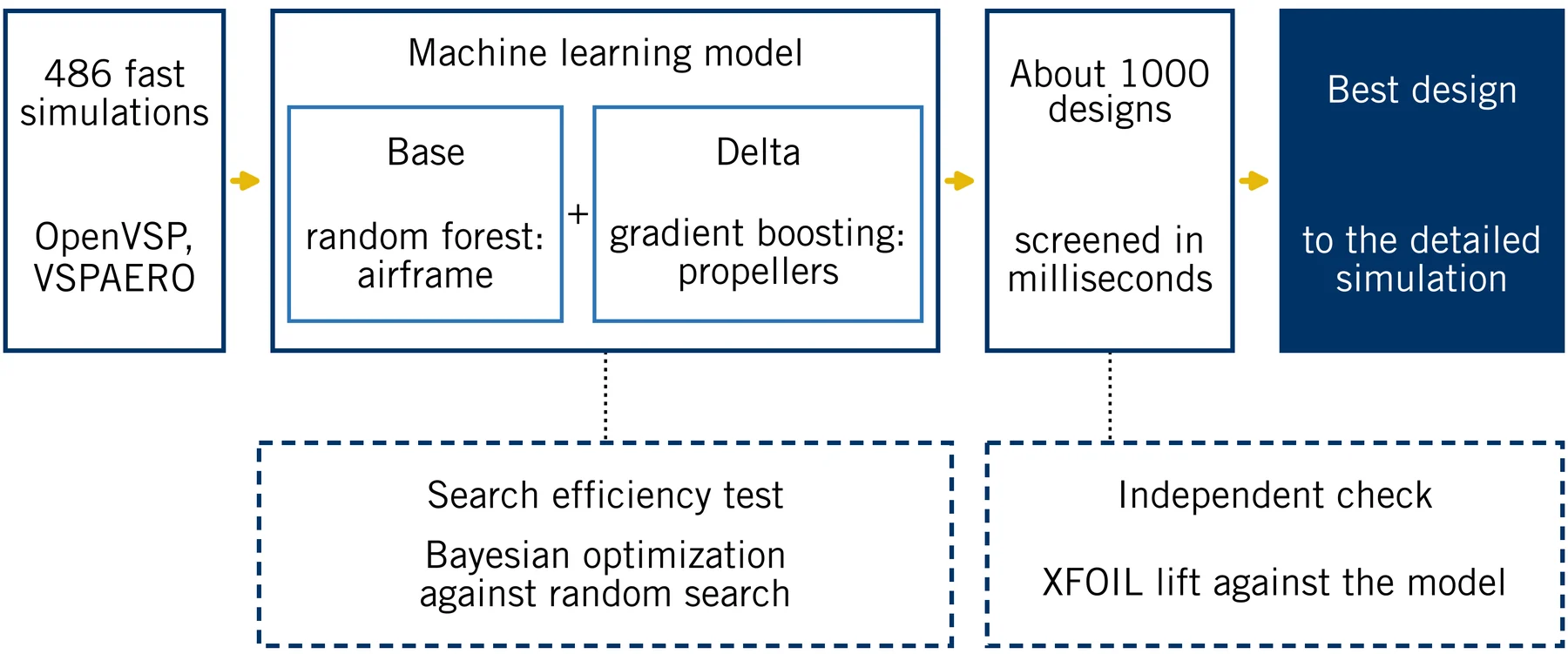
Distributed electric propulsion spreads the thrust over several motors, and motors on the wing also blow air over it for extra lift. Instead of simulating thousands of designs, I let fast solvers and machine learning narrow the search to one, then tested it with a detailed simulation and a wind tunnel. Small quantum algorithms took on three of the steps.
How can an electric aircraft stay over an area as long as possible, when every candidate design takes hours to simulate?
The five stages
Stage 1 of 5
Motor layouts
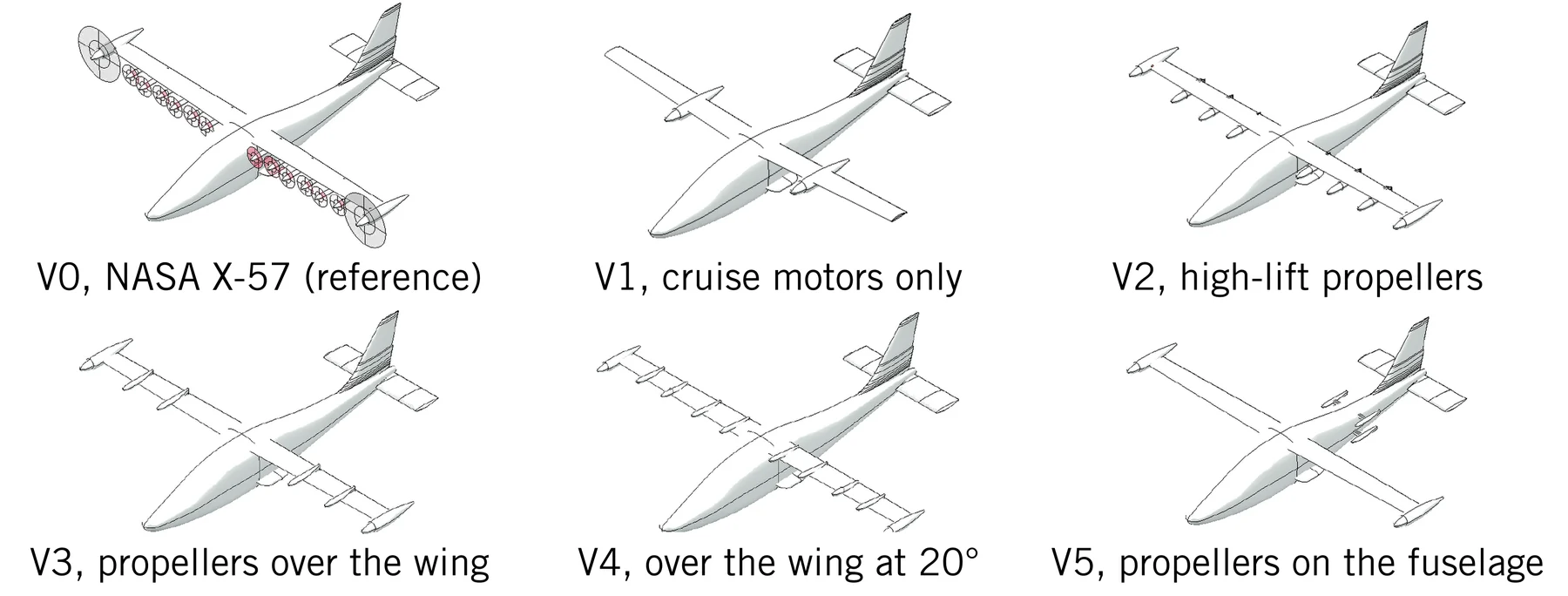
NASA's X-57 layout and five new ones were built on the same airframe and compared in a fast solver. Before any comparison, the solver was checked against NASA's own published simulations of the X-57.
Machine learning
486 simulations varied the wing's thickness, twist, taper and aspect ratio, the angle of attack and the motor arrangement. A model trained on them screened 1000 designs in milliseconds; wing twist turned out to matter most.
Detailed simulation
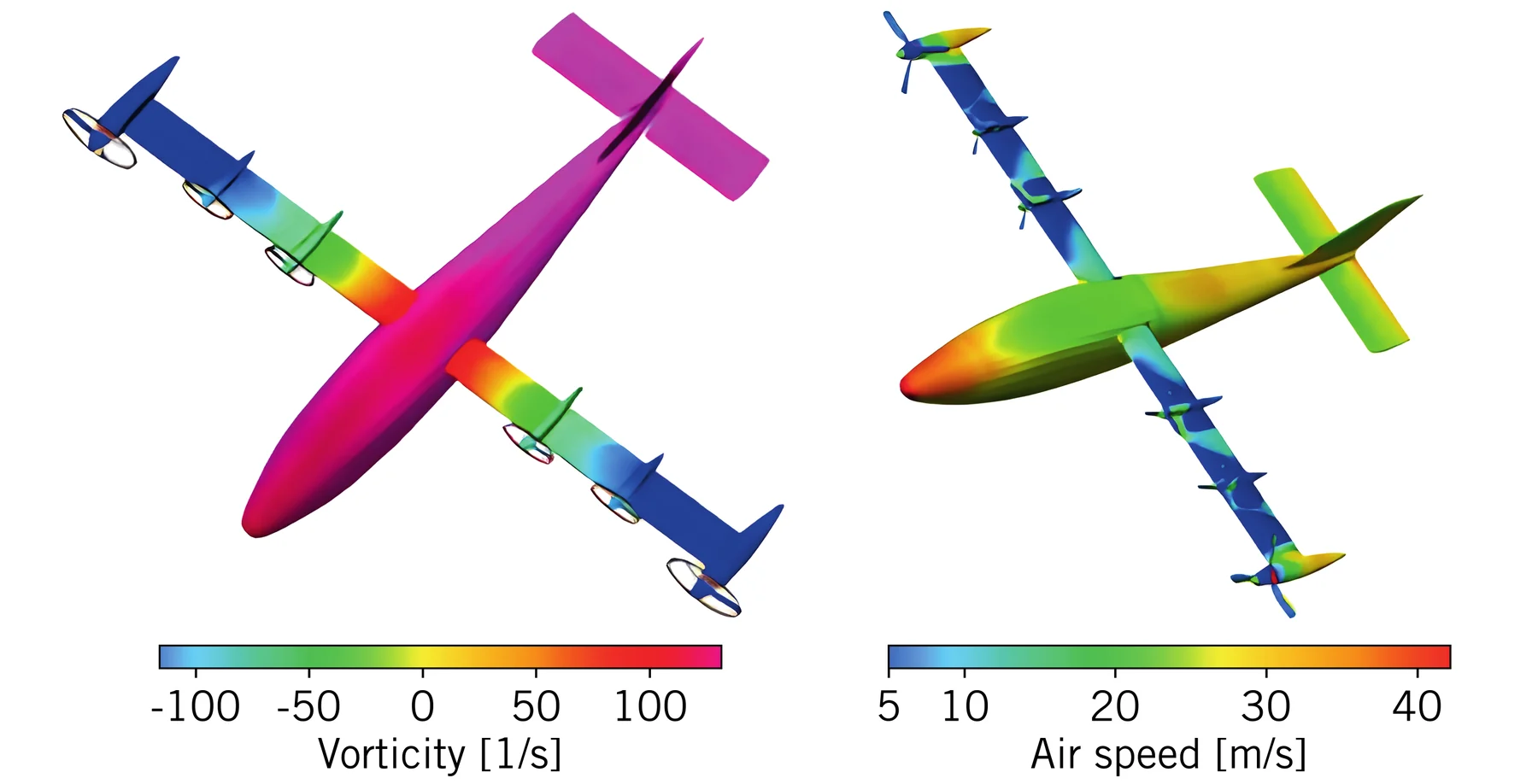
The chosen design was simulated in detail at its mission speed and altitude, with the propellers running. The complete aircraft was then checked against the whole mission: endurance, take-off, noise, battery and motor temperatures, flutter, gusts and a motor failure.
Quantum algorithms
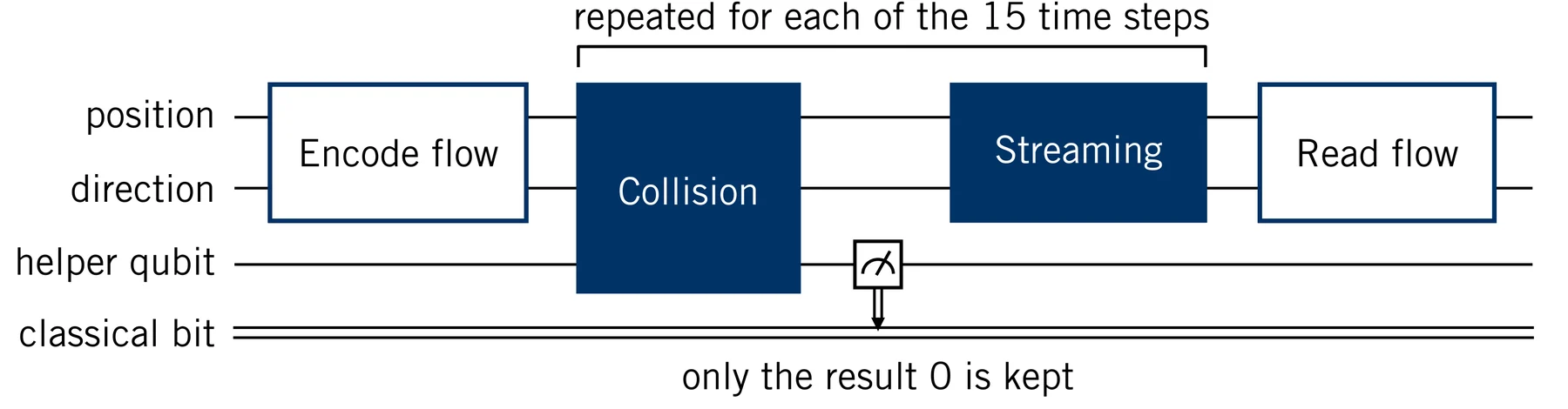
On a quantum simulator, a lattice Boltzmann circuit reproduced the classical airflow exactly, a variational circuit predicted wing-section forces with 87 % agreement, and QAOA found the best motor layout 7.4 times more often than chance.
Experiment
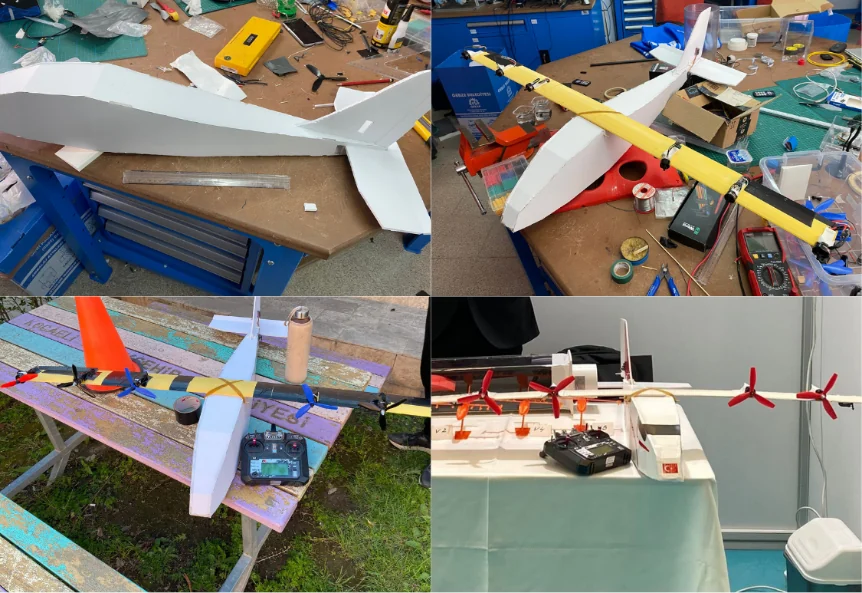
A self-built wind tunnel made the flow over a 3D-printed wing section visible with steam. A 1:9.8 scale model with a 120 cm span was built and balanced for flight tests.
UN Sustainable Development Goals
Disaster response
Hours of quiet monitoring over wildfires and floods help communities respond to climate-related disasters.
Forests and wildlife
Quiet, emission-free flight disturbs forests and wildlife far less.

Faster design
A faster design workflow helps clean electric aircraft move from idea to flight sooner.
In motion
The mission
From take-off to a wildfire 100 km away, and what the sensor sees on station.
Airflow simulation
The detailed simulation of the airflow around the aircraft.
What comes next
Running the quantum steps on real quantum hardware, extending them to three-dimensional flow, and flight-testing the scale model. The same workflow could serve other problems with too many designs to simulate, such as wind turbine blades.
See the numbers
The figures behind each stage, from the first layouts to the wind tunnel.